
One gate, two companies and a $420,000 lesson in WHS responsibility


A broken piece of equipment can become part of the furniture surprisingly quickly. People find a workaround, the work continues, and eventually someone has to explain to a new starter that “it’s always been like that”.
That is the moment worth paying attention to. Familiarity can make a defect less noticeable without making it any less dangerous.
At SMB’s premises in Seven Hills, New South Wales, truck damage in June 2020 disabled powered industrial gates. Workers subsequently moved them manually, and on 24 Mar 22 an 800 kg gate overran its supports and fell onto allocator Christopher Brajbisz. Judge Russell found the risk was known, persisted for 21 months and could have been reduced through inexpensive interim measures. Sentencing judgment, paragraphs 1 to 4 and 58
The question for a workplace reading this case is straightforward: what should have stopped this? Answering it means examining both the physical equipment and the decisions that allow defective equipment to remain in service.

On 25 Aug 26, the NSW District Court imposed convictions and fines. The outcome was:
Defendant | Duty breached | Fine |
|---|---|---|
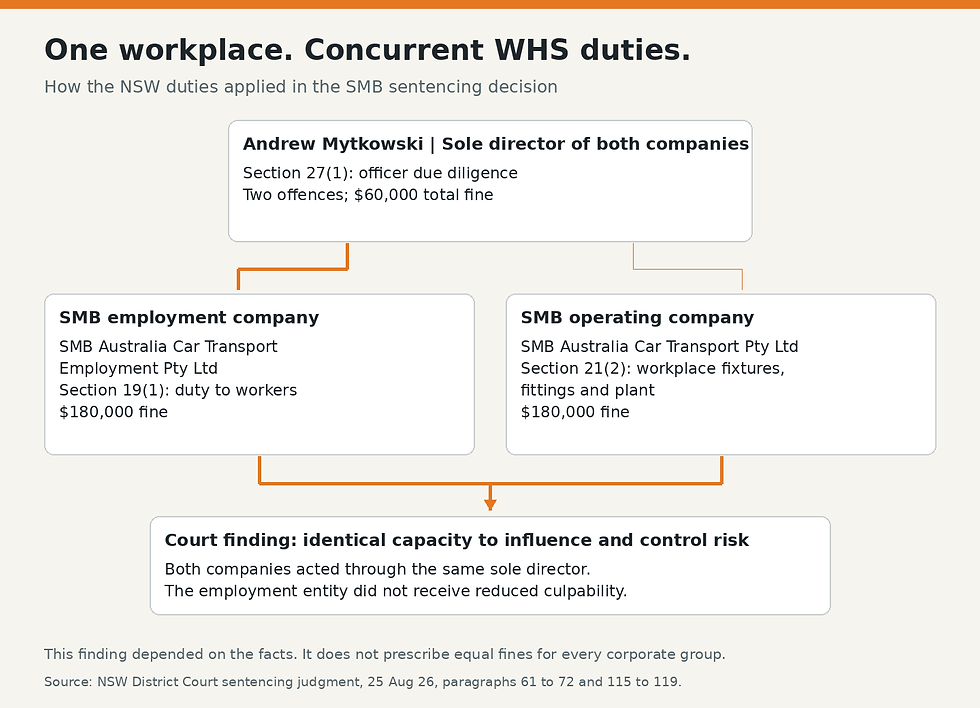
SMB Australia Car Transport Employment Pty Ltd | Duty to workers under section 19(1) | $180,000 |
SMB Australia Car Transport Pty Ltd | Duty concerning workplace fixtures, fittings and plant under section 21(2) | $180,000 |
Andrew Mytkowski, sole director of both companies | Two officer due diligence offences under section 27(1) | $60,000 total |
All defendants pleaded guilty to offences under section 32 of the NSW Work Health and Safety Act 2011. SafeWork NSW announced the outcome on 31 Aug 26 and noted their right to appeal the sentences. SafeWork NSW prosecution release
The corporate reasoning deserves attention. The court rejected reduced culpability for the employment company: through their common sole director, both companies had identical capacity to influence and control the risk. It also rejected the argument that equal corporate penalties amounted to double punishment. Judgment, paragraphs 61 to 72 and 115 to 119
For businesses using separate employment and operating entities, a useful exercise is to map responsibilities against actual decisions. Who can withdraw workers from an unsafe task, authorise expenditure, arrange repairs and verify that work can resume?
A group structure should make those answers clearer. An organisation chart is a poor substitute for someone actually getting the job done.
The underlying NSW duties remain with each duty holder even where responsibilities overlap. SafeWork’s guidance explains that businesses sharing duties must coordinate their activities, and that contracting arrangements cannot simply transfer their legal obligations elsewhere. The practical task is to establish who will implement each control and how the other duty holders will satisfy themselves that it is effective. SafeWork NSW guidance on shared duties
This is a NSW District Court sentencing decision applying the facts of this case. It does not establish that every related company must receive an identical penalty.
The physical lesson also reaches beyond this particular gate. SafeWork NSW warns that disconnecting a powered gate’s drive can disable anti-collision functions, travel limits and speed control, leaving physical stops to prevent overtravel. Damaged stops, guides or supporting posts can allow a gate to fall. These are general gate hazards described by the regulator, rather than a finding that every listed failure occurred at SMB. SafeWork NSW industrial gate guidance
Switching to manual operation therefore deserves a deliberate safety decision. The fact that a person can move something does not tell us whether its supports, restraints and stopping arrangements will safely contain that movement.
An operator’s confidence is particularly poor evidence of structural capacity. Steel does not read the induction register.
SafeWork’s guidance recommends securing a failed gate safely in an open or closed position and arranging competent repairs. If manual operation is unavoidable, it calls for a risk assessment and safe system of work, supported by instructions to users; it also recommends competent inspection and maintenance of gate components. SafeWork NSW industrial gate guidance
My practical recommendation is to treat any proposed workaround as a new operating condition requiring approval. Before approving it, establish what protection has been lost, what additional controls are necessary, who has the competence to assess them and what would require immediate withdrawal from service.
Give the arrangement a review date and a named owner. A temporary measure with neither can quietly become the permanent procedure.
For maintenance management, I would start with the overdue defect list. Look for entries involving damaged equipment, bypassed functions, repeated adjustments or instructions to operate something differently until a repair arrives.
Then ask for evidence of the conditions under which continued use was authorised. A purchase order demonstrates that someone ordered a repair; it does not demonstrate that workers are protected while waiting.
Officer due diligence adds another layer of scrutiny. SafeWork’s guidance describes an active obligation to understand operational risks, ensure resources and processes are available, and check that the organisation’s approach is being implemented effectively. That involves seeking useful information and testing assurances about safety performance. SafeWork NSW guidance on officer duties
For a director, a productive request would be: “Show me our unresolved defects that could seriously injure someone, and explain how people are protected today.” Follow it by checking a sample with the workers who use the equipment.
That conversation gives an officer something concrete to examine. A dashboard showing that maintenance requests have been logged leaves the central question unanswered.
The court credited remorse, cooperation, a clean record and improvements, but refused the director’s request to avoid conviction. His two fines were $15,000 and $45,000, with totality considered; prosecution costs were also ordered. Judgment, paragraphs 76 to 83 and 108 to 135
For my money, the most useful action after reading this case is a walk through the workplace with one question: “What are we currently doing differently because something is broken?” Write down the answers, then check the controls behind each workaround.
You may find the next serious risk in something everyone walks past. Start there, while there is still time to fix it.
For more practical analysis of what should have stopped workplace incidents, subscribe to Safety Jon’s Toolbox Talk newsletter.



Comments