
A Safety Consultant Missed It. So Did the Supervisor. The Conveyor Remained Unguarded.

Painting and Blasting Industries Pty Ltd had a WHS manual.
It had standard operating procedures.
It conducted workplace inspections and toolbox talks.
It had engaged an external safety consultant for approximately a decade.
It had an experienced supervisor with WHS training and accreditation.
What it did not have was an effective control preventing a worker from entering the dangerous moving parts of an outfeed conveyor.
On 05 Oct 22, that gap became a serious injury.

In February 2026, the Industrial Court of New South Wales convicted Painting and Blasting Industries Pty Ltd after it pleaded guilty to a Category 2 offence under the Work Health and Safety Act 2011 (NSW). The company was fined $120,000 and ordered to pay the prosecutor's costs.
The case is useful for reasons extending well beyond conveyors.
It demonstrates the difference between having safety activity and controlling a hazard.
It also raises an uncomfortable question for anyone providing professional WHS advice: if your inspections, audits and procedures repeatedly walk past a foreseeable high-consequence hazard, what exactly is the safety system assuring?
What happened at Wetherill Park
Painting and Blasting Industries operated a steel fabrication business at Wetherill Park in New South Wales.
Its work included boilermaking, welding, grit blasting, priming and painting. One item of plant was a Cogeim shot blasting machine fitted with infeed and outfeed conveyors. Steel was moved through the machine and later removed from the outfeed side using lifting equipment.
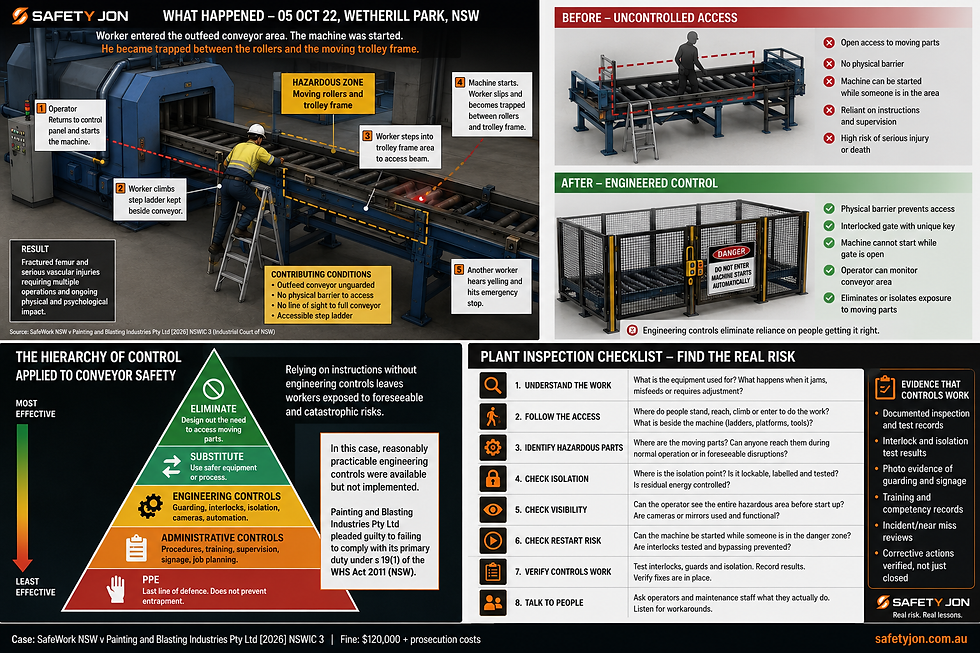
On 05 Oct 22, a labourer and crane assistant were helping move steel through the blasting area.
At about 1412h, a steel beam needed to be moved from the outfeed conveyor. According to the agreed facts recorded by the Court, the blasting machine operator said he needed to return to the control panel to start the machine and that the worker should go to the side of the conveyor after the machine had stopped.
The worker moved a step ladder that was normally kept beside the conveyor, climbed onto the conveyor structure and entered the trolley frame.
The machine was then started.
He slipped between the rollers and became caught between the rollers and the moving trolley frame. Another worker heard him yelling and stopped the machine using the emergency stop.
The worker suffered a fractured femur and serious vascular injuries requiring multiple operations. The judgment also records substantial ongoing physical and psychological consequences.
The important point for safety analysis is not simply that one worker climbed onto a conveyor and another worker started the machine.
The system allowed both things to occur at the same time.
The hazard was sitting in plain sight
Before the incident, the outfeed conveyor was unguarded.
There was no physical control preventing workers from reaching its moving parts.
There was also no warning sign or similar measure preventing access to the area. The machine operator did not have a direct line of sight over the whole outfeed conveyor, and there was no live camera feed covering the area.
The step ladder used immediately before the incident was not an unexpected object that happened to appear beside the machine that afternoon.
The agreed facts recorded that workers used it to access the outfeed conveyor and assist with items positioned on it. The Court considered the ladder's location and use significant, observing that access of this kind appeared to have become routine.
That changes the nature of the safety question.
This was not merely about predicting an unusual act by an individual worker.
There was physical evidence of a recurring work practice involving access to an unguarded conveyor.
A competent inspection of the work should therefore have examined why people needed to access that location, when they did it, what happened to machine energy while they were there, and what physically prevented the machine from starting.
Plenty of safety system, but a hole through the middle
Painting and Blasting Industries was not operating without WHS documentation.
The Court recorded that the company had a WHS and environmental manual, SOPs, employee inductions, toolbox talks, workplace inspections and informal management safety walks.
Its blasting machine procedure had also been reviewed. Workers had participated in SOP consultation during a 2018 review.
The company had additionally retained HSE Support Pty Ltd from 2012 to prepare WHS and environmental audit and inspection reports. Eighteen such reports were completed between July 2014 and the incident, with the latest dated 12 Jul 22.
Yet the blasting procedure did not identify exposure to moving parts of the conveyor as a hazard, nor did it specify a safe method for removing items from the outfeed conveyor.
The crane procedure did not fill that gap either.
Most importantly, none of the consultant reports specifically identified the outfeed conveyor as a hazard. Recommendations made during the 2018 review of the blasting machine procedure did not address it.
That is the operational lesson.
Documentation is evidence of safety administration.
It is not, by itself, evidence that critical hazards have been found.
What the Court said about the consultant and supervisor
The secondary article that brought this case to attention uses much stronger language about the safety consultant than the Court itself.
The judgment is more useful.
Justice Paingakulam accepted that the company had sought to be diligent about safety and had several systems in place before the incident.
Her Honour then described it as “unfathomable” that both the safety consultant engaged to advise on the company's processes and procedures, and an experienced supervisor with WHS accreditation, had failed to identify and address the risk.
That criticism deserves attention without exaggerating what the case decided.
The consultant was not the defendant.
The judgment does not establish some general rule that a WHS consultant becomes personally liable whenever a client is prosecuted.
The company remained the offender and had pleaded guilty to failing to comply with its primary duty, exposing the worker to a risk of death or serious injury.
But the criticism does demonstrate something important about professional safety work.
Engaging an adviser does not transfer the PCBU's duty.
And producing reports that repeatedly miss a significant and observable plant hazard does not transform those reports into effective risk control.
The controls were not mysterious
By pleading guilty, Painting and Blasting Industries accepted that reasonably practicable measures were available before the incident.
They included a safe work system prohibiting operation while workers were on the conveyor, isolation and lockout while workers were accessing it, guarding to prevent access while the machine was operating, and monitoring that allowed the operator to see work being undertaken on the outfeed conveyor.
These are not novel concepts.
The Court noted that risks from unguarded moving plant were plainly foreseeable and described the risk as notorious. Relevant plant guidance available before the incident addressed guarding, interlocking systems, isolation and conveyor safety.
The current SafeWork NSW plant code continues to provide practical guidance on managing plant risks, including guarding and isolation.
This is where the case becomes particularly difficult for a safety system to explain.
The hazard was familiar.
The consequence could be catastrophic.
The access behaviour was occurring.
The controls were known.
Yet the control system did not reliably separate people from moving machinery.
What changed after the incident
The post-incident response is instructive because it provides a comparison between the system that existed and the system that could have existed.
The day after the incident, an internal investigation and risk assessment were undertaken. The blasting procedure was amended and workers were trained in the new requirements. Warning signage was installed.
Cameras were installed so the conveyor area could be monitored.
Following SafeWork NSW notices, the company commissioned specialist risk assessment and engineering work. In April 2023, an electronically interlocked fence and guarding system was installed around the machine.
Access required removal of a unique key which disconnected machine power. The machine could not restart until the worker had exited and returned the key.
That is a materially different control philosophy.
Before the incident, safety depended heavily on procedures, supervision, communication and people correctly coordinating their actions.
Afterwards, the system incorporated a physical and engineered constraint preventing another person from simply restarting the machine while someone remained inside the protected area.
The latter is much harder to defeat through misunderstanding, distraction or an ordinary human error.
The audit question nobody likes asking
The most useful question from this case may not be:
“Do we have a plant risk assessment?”
It may be:
“What would make us confident that our plant risk assessment has actually found the dangerous parts of the plant?”
There is a significant difference.
An audit can confirm that a procedure exists, has a document number, has been reviewed and carries the required signatures.
That tells you something about document control.
It tells you much less about whether a worker routinely climbs a ladder beside an unguarded conveyor.
Good assurance needs contact with the real work.
That can include observing the task, speaking with operators and maintenance workers, examining access points, checking where ladders and improvised tools are stored, reviewing isolation arrangements, examining machine drawings and manuals, testing interlocks, reviewing incident and near-miss data and asking workers what they actually do when material jams or cannot be reached from the normal operating position.
The question is not whether the plant appears compliant while stationary during an audit.
It is whether the system controls foreseeable exposure when production is underway and something does not go to plan.
That systems focus is consistent with the Safety Jon editorial approach of separating controls from the administrative activity surrounding them.
What PCBUs should examine now
For machinery involving conveyors, rollers, chains, gears or other accessible moving parts, a competent review should examine at least the following:
where a person can reach, climb, crawl or fall into moving machinery
whether access is required during normal operation, clearing, adjustment, cleaning or maintenance
whether fixed or interlocked guarding prevents access
whether isolation genuinely removes hazardous energy before entry
whether restart can occur while a person remains exposed
whether operators can see all hazardous areas before starting machinery
whether ladders, platforms, tools or wear patterns reveal unofficial access practices
whether SOPs describe the actual work rather than the intended work
whether previous audits tested physical controls or mainly reviewed documents
whether supervisors recognise the critical hazards they are expected to monitor
whether recommendations have been closed administratively or verified in operation.
The last point matters.
A corrective action marked “complete” is not the same thing as a control demonstrated to be effective.
The current NSW legal context
The offence occurred in 2022 and was prosecuted under the Work Health and Safety Act 2011 (NSW), with the judgment also referring to the Work Health and Safety Regulation 2017 that applied at the time. Painting and Blasting Industries pleaded guilty to a Category 2 offence arising from breach of its primary duty under section 19(1).
The current NSW legislation should be checked separately from the historical provisions applying to the event. As at 07 Aug 26, the Work Health and Safety Act 2011 remains in force and the Work Health and Safety Regulation 2025 has replaced the former 2017 Regulation.
NSW also changed the status of approved codes of practice from 01 Jul 26. SafeWork NSW states that the new section 26A requires PCBUs to comply with an approved code or manage the hazard in another way providing an equivalent or higher standard. That is relevant to organisations reviewing plant controls now, although it did not create the duty applicable retrospectively to this 2022 incident.
The professional lesson for safety practitioners
This case should not become an excuse to attack consultants.
That would waste it.
A safety adviser can be competent and still miss something. A supervisor can be experienced and still normalise a dangerous practice. An organisation can have a substantial safety system and still leave a serious hazard uncontrolled.
The answer is not another layer of paperwork designed to prove that somebody inspected something.
It is stronger assurance.
When inspecting plant, get close enough to understand how the work is really done.
Follow the material flow.
Ask what happens when it jams.
Ask where people stand.
Ask what they climb on.
Ask who can restart the equipment.
Ask what prevents that restart.
Then look for physical evidence that contradicts the procedure.
In this case, the ladder beside the unguarded conveyor was telling part of the story before the incident occurred.
The safety system needed to notice it.


Comments