
The Excavation Was Already Failing

A 20-year-old student fell three metres after the ground beneath her gave way. The warning signs were visible, but the work continued.
A large excavation does not become safe because the people working around it know it is there. It does not become stable because the job will only take a while, and it certainly does not care whether the person standing at its edge is an experienced contractor, a first-year apprentice or an engineering student helping pass someone a bottle of water.
In March 2024, workers from JS Armstrong Water Tanks Pty Ltd were preparing a residential site in Keysborough for the installation of an 89,000-litre water tank. A 20-year-old engineering student assisting with shovelling work leaned over the edge of the excavation to pass a bottle of water to someone below.
The ground beneath her gave way. She fell approximately three metres into the excavation, landed on a brick and suffered a fractured vertebra, spinal tenderness and whiplash.
On 06 Aug 26, JS Armstrong pleaded guilty in the Dandenong Magistrates’ Court to one charge of failing to ensure that a workplace under its management and control was safe and without risks to health. The company was convicted, fined $50,000 and ordered to pay $4,452 in costs.
The fine is the court outcome. It is not the principal safety lesson.

The ground was giving a warning
A WorkSafe investigation found that the excavation had no warning signs, fencing or battering. Soil was also observed peeling away from the excavation walls while workers were inside.
That last fact matters because this was not a perfectly stable excavation that failed without warning. The condition of the excavation was providing observable evidence that the ground could not be relied upon to remain where it was.
The system should have responded to that evidence by stopping the work, removing people from the excavation and reassessing the controls. Instead, work continued with people inside the excavation and others able to approach its unprotected edge.
The incident was not caused by a student leaning too far forward. She was placed in a position where an ordinary movement, undertaken for an entirely ordinary reason, exposed her to a three-metre fall because the ground beneath her had not been stabilised and access to the edge had not been controlled.
Telling people to be careful around that arrangement would not have fixed it. Gravity has never shown much interest in toolbox talks.
This was more than a fall hazard
It would be easy to describe this only as a fall from height, but the circumstances involved several connected excavation hazards.
There was a risk of a person falling into the excavation. There was also a risk of material collapsing or slipping from its walls onto people working below, particularly where soil was visibly peeling away.
There was no defined safe access point, which affected how workers and materials could enter the excavation. There was also no physical exclusion system preventing workers, students, residents or other people at the residential property from approaching unstable ground near its edge.
These were not remote or theoretical risks. The excavation was three metres deep, people were working inside it and the surrounding ground was already showing signs of instability.
Under Victoria’s construction safety framework, construction work involving a trench or shaft deeper than 1.5 metres is classified as high-risk construction work.
Construction work involving a risk of a person falling more than two metres also falls within that classification.
A safe work method statement must be prepared before high-risk construction work begins, and the work must then be performed in accordance with it. The public prosecution material does not state whether a SWMS existed in this case, so it would be wrong to declare that one did not, but a document sitting in a vehicle would not explain away an unbattered excavation with no fencing, warning barriers or controlled entry.
A SWMS is only useful when it accurately describes the site, nominates effective controls and governs the work being performed. If the soil begins peeling away and the document does not cause the work to stop, the paperwork and the work have parted company.
Reasonably practicable controls were available
JS Armstrong admitted it was reasonably practicable to reduce the risk by:
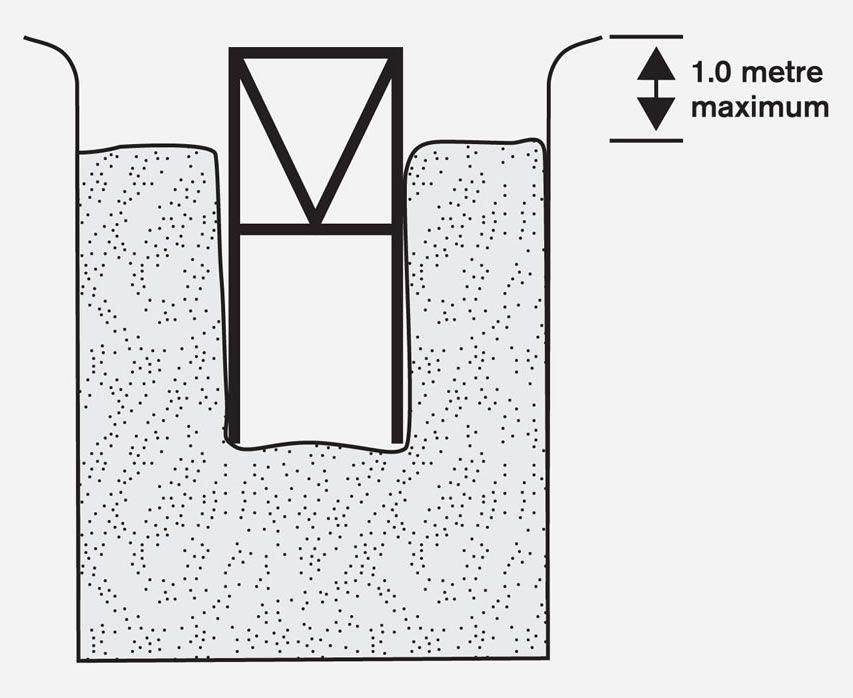
battering the sides of the excavation
providing a safe entry point
placing barricades or warning barriers at least one metre from the excavation edge before work commenced.
Those controls address different parts of the risk and should not be treated as interchangeable. Battering addresses ground stability, while a safe access point controls how people enter and leave the excavation.
Barricades establish separation from the edge, and warning signs communicate the hazard. A sign by itself, however, does not stabilise soil or physically prevent someone approaching the collapse zone.
Depending on the ground conditions, excavation geometry and work being performed, appropriate controls may also include benching, shoring, trench shields, engineered ground support, guardrails, secured covers, competent geotechnical assessment and an emergency response arrangement. The controls must be selected for the actual excavation, not copied from the last SWMS because the heading happened to mention dirt.
The condition of the ground must also be monitored as work proceeds. Rain, vibration, nearby plant, surcharge loads, spoil placement, underground services and previous ground disturbance can change excavation stability after the initial assessment has been completed.
“She was only helping” changes nothing
The injured person was described as an engineering student assisting at the site. The public material does not establish whether she was there under a formal placement, employed in another capacity or assisting through some less formal arrangement.
For prevention purposes, the distinction changes very little. Once a person is allowed to participate in work or enter a workplace under a company’s management and control, their exposure must be addressed through the system of work.
A student should not be treated as a spare pair of hands who can be slotted into whatever task needs doing. Their likely unfamiliarity with the site, limited practical experience and reluctance to challenge an experienced worker require more deliberate task selection, induction, instruction and supervision.
That does not mean surrounding them with paperwork and preventing them from learning. It means selecting work they can perform safely, explaining the hazards they may not recognise and ensuring the physical controls do not depend upon them having the judgement of a worker with 20 years in the trade.
In this incident, the student was not performing an inherently complex act. She was passing water into an excavation, which demonstrates why effective controls must account for normal human movement around the task rather than only the formal steps listed in a procedure.
Residential sites are still workplaces
The incident occurred at a residential property, but workplace duties do not disappear when construction moves away from a fenced commercial project. Residential sites can present a more difficult control environment because residents, visitors, delivery drivers, students and contractors may move through areas that were never designed to operate as construction workplaces.
An excavation of this size required deliberate site control before workers entered it. That included defining the work zone, controlling access, keeping people away from unstable edges and ensuring the excavation remained stable for those required to work below ground level.
A length of tape strung between two star pickets may indicate where someone hoped people would stop. It is not automatically an effective barricade, particularly where the foreseeable consequence is a three-metre fall or burial under collapsing material.
The decision point came before the fall
The significant decision was not made when the student leaned over the edge. It was made when work was allowed to begin, and then continue, without the excavation being battered, safely accessed or isolated from approaching people.
Another decision point arose when soil was seen peeling from the excavation walls. That was an indication that the existing arrangements were not controlling the risk, and the correct response was to stop, withdraw and reassess.
This is where safety systems are tested. The test is not whether a company has a SWMS template, an induction form or a statement on its website describing safety as a priority, but whether observable evidence of control failure causes the work to stop before someone is injured.
In this case, the person who discovered that the edge was unstable did so by falling through it.
The practical lesson
Before anyone enters or works near an excavation, the person managing the work should be able to answer several operational questions. They should know who has assessed the ground conditions, what prevents wall collapse, what keeps people away from the edge, where spoil and plant may be placed, how people will enter and leave, who is supervising the work and what will happen if the conditions change.
For high-risk construction work, those answers must be reflected in a site-specific SWMS and implemented in the field. Workers, students and contractors should be able to identify the exclusion zone and understand the conditions requiring an immediate stop.
The broader lesson is not that students need to be more careful near excavations. It is that no person should have been able to approach that edge, and no one should have been working below while the excavation walls were visibly deteriorating.
The ground was already providing the warning. The system failed to listen.
Sources: WorkSafe Victoria, Water tank company fined $50,000 after three-metre fall, WorkSafe Victoria, Safe Work Method Statements, Dandenong Star Journal report


Comments