
Run a 20‑minute bushfire readiness drill

Here is a quick, realistic 20 minute family drill you can run this weekend to stress test bushfire readiness, power loss, and comms failure, without spending money.
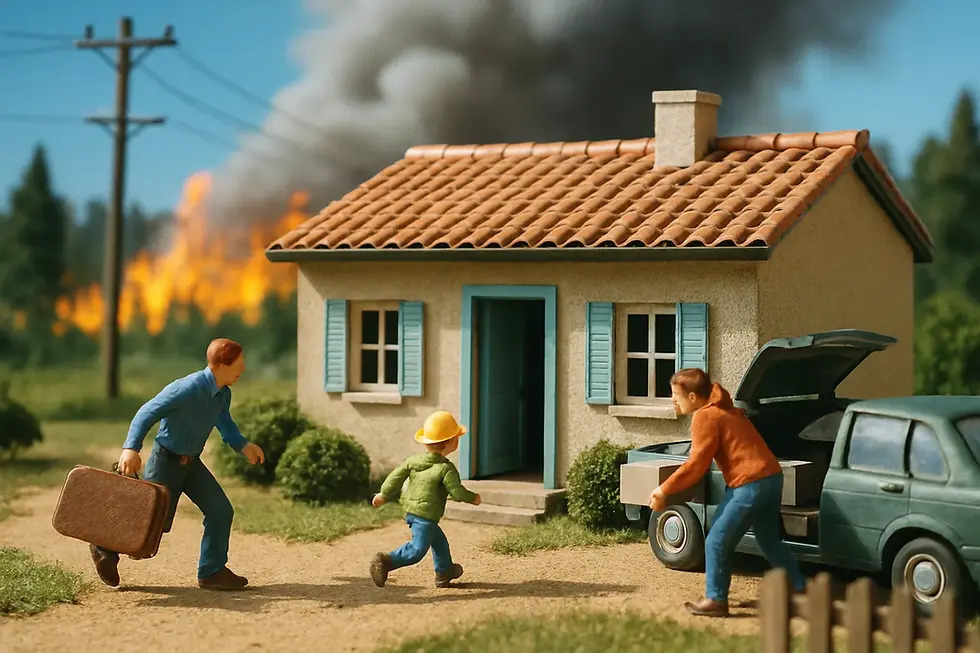
Purpose
Practice getting people, pets, valuables, and go-bags into the vehicle quickly, then identify gaps in lighting, communications, and decision-making.
Set up
Pick a 20-minute window. Use 24h time. Example 10 Nov 25 at 1600h.
Agree safe rally points: Primary is the driveway by the vehicle, alternate is the footpath outside the letterbox.
Preload a simple trigger phrase: “Action. Evac level.”
Decide roles: Lead, Pet wrangler, Docs and valuables, Vehicle and power down, Perimeter check.
Staging: Park forward-facing. Put empty tubs in the boot to contain loose items.
Injects to simulate
Power out at start. No mains lights. Use headlamps and torches only.
Smoke approaching from the north. Close up the house.
Comms failure at minute 10. Phones are treated as having no service.
Curveball at minute 15. Example dog slips collar or gate is stuck.
What you will practice
Rapid decision making using triggers you already accept, not gut feel
Movement of people and pets along one safe internal route
Shutting windows, external doors, evap cooler intake, and gas bottles off at the valve
Loading prewritten A, B, C lists without thinking
The 20-minute timeline
00 to 02 min: Lead calls “Action. Evac level.” Everyone puts on enclosed shoes, long pants, and long sleeves. Headlamps on. Open the vehicle, boot up.
02 to 06 min: Pet wrangler crates animals, attaches spare tags, sets water. Vehicle and power down turns off evap cooler, fans, non-essential breakers if safe, kills gas at bottles.
06 to 10 min: Docs and valuables grab folder, wallets, meds, chargers, backup drives, passports, essentials tub A. Perimeter checks windows shut, gutters clear at downpipe strainers, hoses connected, bins moved away from walls.
10 to 15 min: Assume phones fail. Switch to handhelds if you have them, or use shouts and hand signals. Load tubs B and C if time.
15 to 18 min: Curveball inject. Resolve, then resume.
18 to 20 min: Everyone seated, pets secured, doors counted and verified, garage shut, address sign visible. Do not drive, just reach a ready state.
Minimum load lists
List A first 10 minutes: People, pets, meds, wallets, keys, phones, chargers, ID folder, go bags, water.
List B next 5 minutes: Laptops, backup drive, cash, glasses, hard copy contacts.
List C last 5 minutes: Sentimental items that actually fit.
Safety controls
Do not use real smoke. No candles. Use a timer and voice only.
Keep one person off tools to manage tempo and call time.
Debrief 10 minutes
Immediately after the timer, use this scoring sheet, rating it out of 5.
Time to ready state seated and belted
Pet containment and load
Lighting adequacy without mains
Comms plan without phones
House shut-down completeness
Vehicle readiness and staging
Stress behaviour and clarity of roles
Write answers to four questions:
What worked
What failed
What was missing
What we will fix by two weeks from now
Likely gaps to expect and how to fix
Comms: Print a one-page contact tree. Add two cheap UHF handhelds with spare AA trays. Program your local simplex and family channels.
Lighting: Headlamps for each person plus two spare torches. Keep one torch clipped to the main switchboard.
Time loss: Pre-pack a pet's kit and a labelled meds pouch. Move List A items to a single shelf near the exit.
Vehicle staging: Keep the boot tubbed and half empty. Park nose out with at least half a tank.
Specific reminders
Replace the evap cooler pad or fit a blanking cover before peak season if embers are a risk.
Print your local Fire Authority warnings information, brigade UHF scan plan (if you monitor), and township protection plan (if available).
It's better to be prepared than not...


Comments